

Issue No. 51 December 2025 (£2.00)
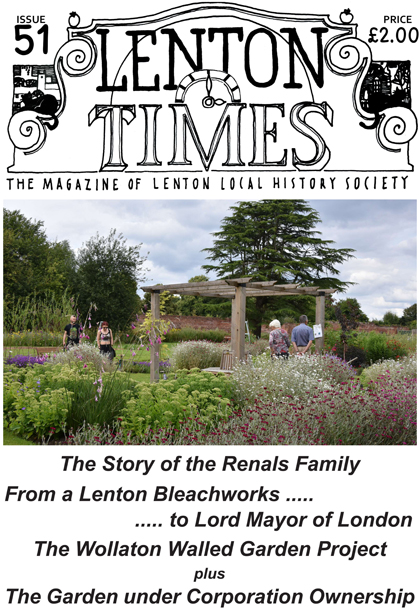
Wollaton Hall's Walled Kitchen Garden Under Corporation Ownership (5 pages)
In Lenton Times No.50 we provided a brief account of the walled kitchen garden when the hall and parkland were all owned by the Willoughby family. Alongside it we included an article about Frederick William Parkes who was the Willoughbys' last head gardener at Wollaton and who then became the park's superintendent following its acquisition by Nottingham Corporation. We now focus on the more recent history of the walled kitchen garden.
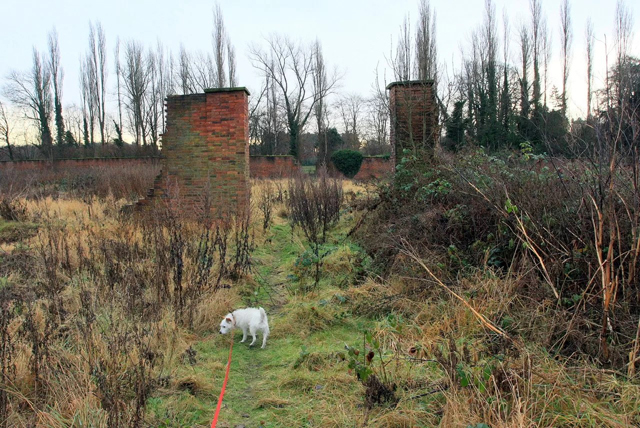 In May 1925 Nottingham Corporation completed the purchase of Wollaton Hall and the surrounding parkland from Michael Guy Percival Willoughby, the 11th Baron Middleton. This means it has now been owned by Nottingham City Council for exactly one hundred years. Next year [2026] the City Council intends to shine the spotlight on the Hall and the natural history museum housed within it, which first opened to the general public on 28 October 1926. This centenary will be justly celebrated in the coming year. It is clear that the city councillors didn't retain the same sense of pride in one of the other sets of buildings they acquired back in 1925. Almost immediately the walled kitchen garden was leased off to a private tenant. It would appear that the Corporation didn't maintain a watchful eye on what was happening there.
In 1939 it realised that the property had suffered deterioration and as the tenant was not in a position to put matters right the councillors were proposing to demolish the walled garden and have houses built there. Only the advent of World War II stopped this from happening. After the war it looked as though the walled garden was going to be demolished for school playing fields but fortunately that didn't happen either. Even though the walled garden had been Grade II listed in 1989 little or no council money was ever spent on it.
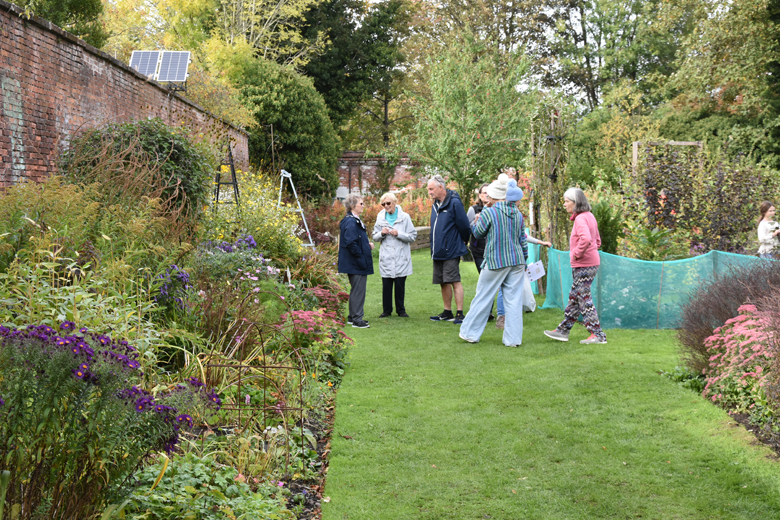
Wollaton's Walled Garden: The Project (4 pages)
Wollaton's Walled Kitchen Garden had essentially been abandoned by the City Council but in 2014 Wollaton Historical and Conservation Society and the newly formed Friends of Wollaton Park agreed to see if there was some way they could persuade the City Council to adopt a more positive attitude to the garden. Several years were spent in meetings with the Council but, with the support of Steve Battlemuch who had become a Wollaton councillor in 2013, a small pot of money was found so that Kyle Heesom, Wollaton Park's head ranger, and some of his fellow rangers could make a start on clearing some of the ivy and brambles from the walled garden. Once this had happened it was agreed that volunteers from Friends of Wollaton Park would help them with this work. It was also agreed that the City Council should have some critical repairs to the walls carried out. So the volunteers spent many hours clearing vegetation and cleaning up some of the fallen bricks so that they could be used in the proposed repairs. In February 2019 the walled garden was opened to the public for a whole week and it attracted a large number of people eager to see what lay within the walls. Crucially it also attracted some more volunteers. Our article explores how the project has developed in the succeeding years.
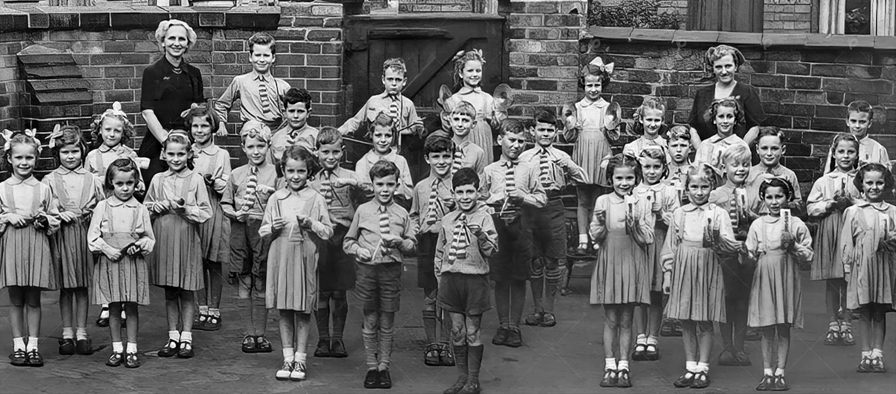
Lenton Council Infants School (1 page)
A recent addition to the Lenton Times website is a 1951 photograph of the pupils' percussion band at Lenton Council Infants School taken in one of its playgrounds. We have yet to put names to the children but we can identify the two teachers in the photograph. This short article provides brief biographies of the class teacher, Miss Dorothy E. Skidmore, and Miss Margaret I. Lewin, the headmistress.
The Renals Family of Lenton & Elsewhere (6 pages)
Robert Mellors' booklet: Lenton: Then and Now [pub. 1914] includes a passing mention of the Renals family. The author stated that: Alderman John Renals, J.P., Sheriff of Nottingham, 1875, and Mayor 1888, and Sir Joseph Renals, Bart., Lord Mayor of London, 1894, were twin brothers, born of an old and respected Lenton family. He had nothing else to say about these two individuals or indeed about the rest of the Renals family. In 1924 Robert Mellors went on to publish: Men of Nottingham and Nottinghamshire - Being Biographical Notices of Five Hundred Men and Women who were born, or worked, or abode, or died in the county or city of Nottingham, and who, in some way, were distinguished for usefulness to others. Neither of the Renals brothers gained inclusion in this second publication. Our articles rectifies this deficiency.
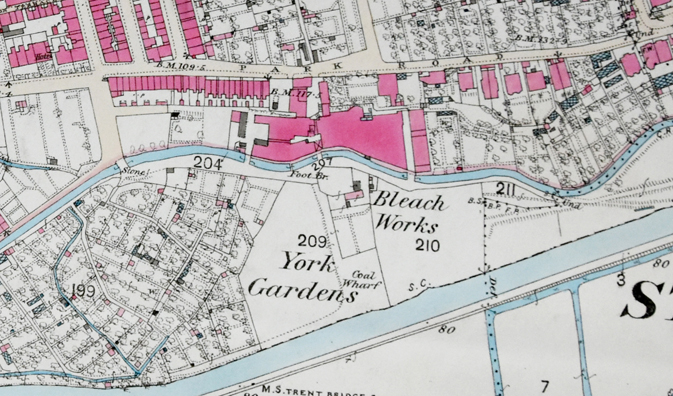 The Renals brothers acquired their Lenton bleach works after the death of their uncle, John Burton in 1867. Joseph would leave the bleach works in 1876. His brother, John remained in Nottingham and went on to play a significant role in the public life of Nottingham as a councillor and later as a Nottingham alderman with a longstanding interest in the Castle Museum.
This article provides the reader with the history of the bleach works during the nineteenth century while also refuting Robert Mellors' suggestion that the Renals were 'an old and respected Lenton family.'
Alderman Sir Joseph Renals 1st Baronet (2 pages)
Suffering from a lengthy bout of ill-health Joseph Renals had decided to end the partnership with his brother and retire from the business at the early age of thirty-three. So Joseph settled down to the life of a country gentleman with his wife and children in the village of Ruddington. After a few years of enforced idleness his health improved and he decided to resume his business career in London.
In December 1885 Joseph Renals was selected as a representative for the Aldersgate Ward of the Corporation of London to sit on the Court of Common Council. He was returned unopposed in 1886 and was among those re-elected in 1887. In February 1888 Joseph Renals was chosen to be the Alderman for the Aldersgate Ward which meant he retained his position on the Court of Common Council for the rest of his life. It also meant he became a City magistrate. By 1892 he had also become a governor of the Royal Hospitals; an almoner of Christ's Hospital; governor of Queen Anne's Bounty; a member of the Spectacle Makers' Company, a member of the Gold and Silver Wyre Drawers' Company; and one of her Majesty's Lieutenants for the City of London.
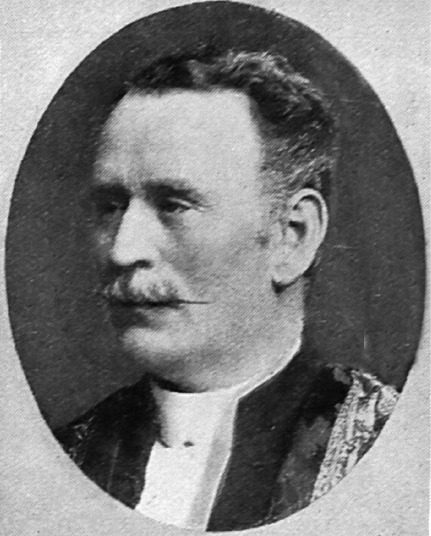 In September 1892 he was selected to be one of the two Sheriffs of the City of London - a post that lasted a year. Those who had held the office of sheriff were frequently awarded a knighthood. The one granted to Renals arrived in July 1893. Having served as sheriff, Joseph Renals now became eligible to be selected as Lord Mayor who also became the chief magistrate of the city during his year in office. Renals didn't have to wait very long. Our article goes on to look at his year in office and his subsequent career as a London businessman.
The article concludes with brief biographies of his other brothers and sisters.
The Three Sons of Joseph and Mary Renals: Their Stories (3 pages)
Joseph Herbert Renals (1870-1927):
His story is very much one of riches to rags. When his father died Joseph Herbert succeeded to Renals' baronetcy. He would die in the Brighton Poor Law infirmary in 1927 suffering from malnutrition and the nation's newspapers would cover the story with headlines such as 'Baronet Dies of Poverty.'
John Burton Renals (1872-1934)
He enjoyed a perfectly ordinary career working on the London Exchange and almost certainly paid for his older brother's funeral down in Brighton.
Alfred Wilson Renals (1877-1915)
Alfred also enjoyed a career in the London Stock Exchange but was clearly more interested in playing sports and chasing after women. He was cited in the divorce of John Nicholl Still and his wife, Amy Georgina Still in 1909. Renals subsequently married Mrs Still but they were not destined to be together for very long before he died of 'chronic alcoholism & delirium plus heart dilatation and failure.' His wife only survived for four more years before departing this life in a private asylum in 1919.
The Cotton Family of New Lenton (2½ pages)
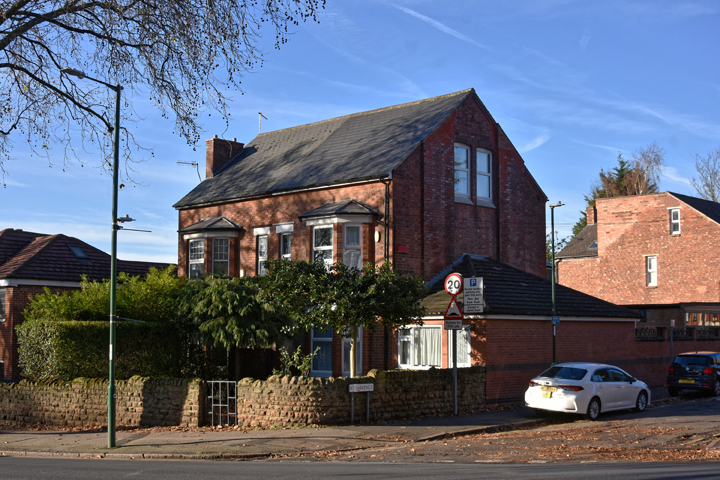
Trevor Cotton's childhood homes were both in Lenton and both on Derby Road. He describes his life here as the youngest of six children. He has followed Notts County F.C. since he was a boy and tells us something of his time supporting them. There is his apprenticeship as a joiner with the Lenton building firm of W.T. Norris and, following the demise of this particular business, concluding his apprenticeship with John H. Brough & Co. (Builders) Ltd. then based in Beeston on Station Road. Trevor concludes his reminiscences with his courtship and subsequent marriage to Susan Valerie Petty and the birth of their two children.
The Cotton Family: A Deeper Dive into their Past (1½ pages)
In this article we look at Trevor's Cotton family in more detail and discover Lenton links that stretch back at least to his paternal grandfather.
The West Nottingham Virtual Memorial & Reginald Dennis Bell (2 pages)
In the course of their researches those involved in the creation of the Nottinghamshire WWI and WW2 Roll of Honour website have come across a number of individuals who died in the Great War whose names do not feature on any known memorial. So, on the website, they have created a number of Virtual Memorials focusing on different areas of the city. Those Great War fatalities found to have Lenton connections have been included in the 'Nottingham West' Virtual Memorial.
There is a chapter in Nottingham at War 1914-1919 & Lenton: A Suburb's Sacrifice [pub.2014] which provided profiles of some ninety-two individuals who had Lenton connections but whose names were not to be found on the Lenton War Memorial - the memorial erected in 1920 at the junction of Church Street and Sherwin Road. Some of them are also listed on the 'Nottingham West' Virtual Memorial. There are, however, others that did not make it into the book. One of them was Reginald Dennis Bell.
Our article looks at Reginald's parents, their deaths which meant that he and his two surviving siblings ended up in various orphanages. We reveal what happened to both his brother and sister, who survived into old age. We also find out more about Reginald Bell and that his name does feature on a war memorial - just not one in Nottinghamshire.
Society Snips (2 pages)
Lenton Times - Issue 51 - Downloadable PDF Version
Once the payment is confirmed, we will send you details of the download link.
The link will be available online for 2 weeks from the date of notification.
Next Issue: Lenton Times No.52 should be available in June 2026.