

Issue No.4 June 1990
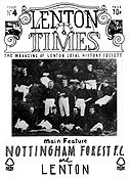 Nottingham Forest
and Lenton
Nottingham Forest
and Lenton
For some seven seasons in the 1880s Nottingham Forest F.C. played
their home matches at grounds in Lenton. A piece of sharp practice by their local
rivals, Notts County F.C., meant Forest lost the use of the Trent Bridge cricket
ground and, in the summer of 1883, was forced to look elsewhere. The move to the
Parkside Ground in Lenton was not an unqualified success. The pitch sloped badly
and the playing surface was rather uneven. The local press also thought the ground
was situated too far out of town. The Club persevered with the ground for two
seasons and then decamped to the Gregory Ground, also in Lenton. This time the
newspapers were full of praise for the new ground even though it was further from
the centre of town. Forest stayed here for five seasons until the Club decided it
didn't really fit the bill and in 1890 moved to the Town Ground in the
Meadows.
Set alongside an account of Nottingham Forest's footballing exploits the article
explores the changes in the game - the introduction of professionalism, the
creation of the Football League, Forest's first experiment with floodlights - all
of which happened while Forest was in Lenton.
The Campus: Facing up to its past
On the University campus there is a cliff face traditionally
thought to be the work of the river Trent at the time when it flowed in a different
pathway. In his article Frank Barnes reveals that the cliff face is of much more
recent origin. It was created in then under construction. Using Frank Barnes' help
the reader can even discover on the first Ordnance Survey map of  1839
the presence of a temporary rail track laid to transport rock from the cliff face
down to the railway line.
1839
the presence of a temporary rail track laid to transport rock from the cliff face
down to the railway line.
History on a Plate
Brian Howes is a keen collector of early advertising material. In
1983 he popped into a city centre pub undergoing a major refurbishment to ask if
anything of interest was being thrown out. There was nothing in the advertising
line but the workmen reported that they had come across a huge pile of glass
photographic negatives stacked in an upstairs room. They had taken a few samples to
a nearby antique/junk shop but as the proprietor had shown no interest the plates
had been loaded into the builders' skips. Most of the plates had already gone off
to the tip by then but Brian persuaded the builders to give him a few of those that
remained some forty plates. When he got them home he could see that they showed
people standing outside their homes or in front of shop premises. Suitably
intrigued he asked a photographer to make a contact print of each slide. After a
lot of detective work it became clear that some ten of them were taken of people
and properties in Lenton and that the photographs dated from the mid 1920s. A
couple of others were probably of locations elsewhere in Nottingham but the rest
remained unidentified.
Our article tried to offer answers as to how these glass plates had come to be in
that particular pub and what exactly the photographer was up to. It seems that
inadvertently the builders may have discarded a major photographic
archive.
More about Mr Mitchell
Iris Keeble's article in our last issue spurred Frank Barnes to add a little more to the sum of our knowledge about her great grandfather, David Mitchell.
Anyone for Golf?
This is our feature on Lenton Lane Golf Driving Range who sponsored Issue No.4.
Society Snips
The Society's recent news section.
Editorial for this issue

Photograph of Nottingham Forest first team in 1884.
Back Row - T. Danks, C.J. Caborn, S.W. Widdowson, T. Lindley.
Middle Row - H. Billyeald, T. Hancock, F. Fox, A. Ward.
Front Row - S. Norman, J.E. Leighton, F.W. Beardsley, G. Unwin.
Photo courtesy of Nottinghamshire County Library Service
Nottingham Forest F.C. once played football here in Lenton. As
Michael Caine might say 'Not many people know that'. If this fact didn't come as a
surprise, you've probably been reading Forest 1865-1978 by John Lawson or one of
the other recent publications on the history of the Club. Forest first came to
Lenton in 1883 (not 1882 as most writers erroneously state) and stayed for seven
seasons before moving to a ground in the Meadows in 1890. The principal reason for
Forest's departure is usually given that the Club was unable to attract enough
spectators because their ground was too far out of town. Certainly Forest failed to
attract adequate support but then the first eleven weren't playing very well. Had
they been able to achieve better results, the Club might have attracted larger
attendances and, who knows, Forest might still be playing in Lenton. Then again if
they had stayed here the Club might well have gone the way of Notts Rangers and
Notts Olympic - into relative obscurity or even oblivion.
Those who have so far written about Nottingham Forest have largely cold shouldered
the 'Lenton' era. Possibly this is because of the paucity of original material. The
Club itself has little or nothing in the way of early records. Those documents that
weren't ruined in the floods of 1947 were destroyed when the main stand caught fire
in 1968. Our own article relies heavily on contemporary sports reports in the local
press. Reading through seven years' worth of match reports and sporting comment,
all on microfilm at the Local Studies Library, was a daunting task. We earnestly
hope readers consider it was worth the effort.